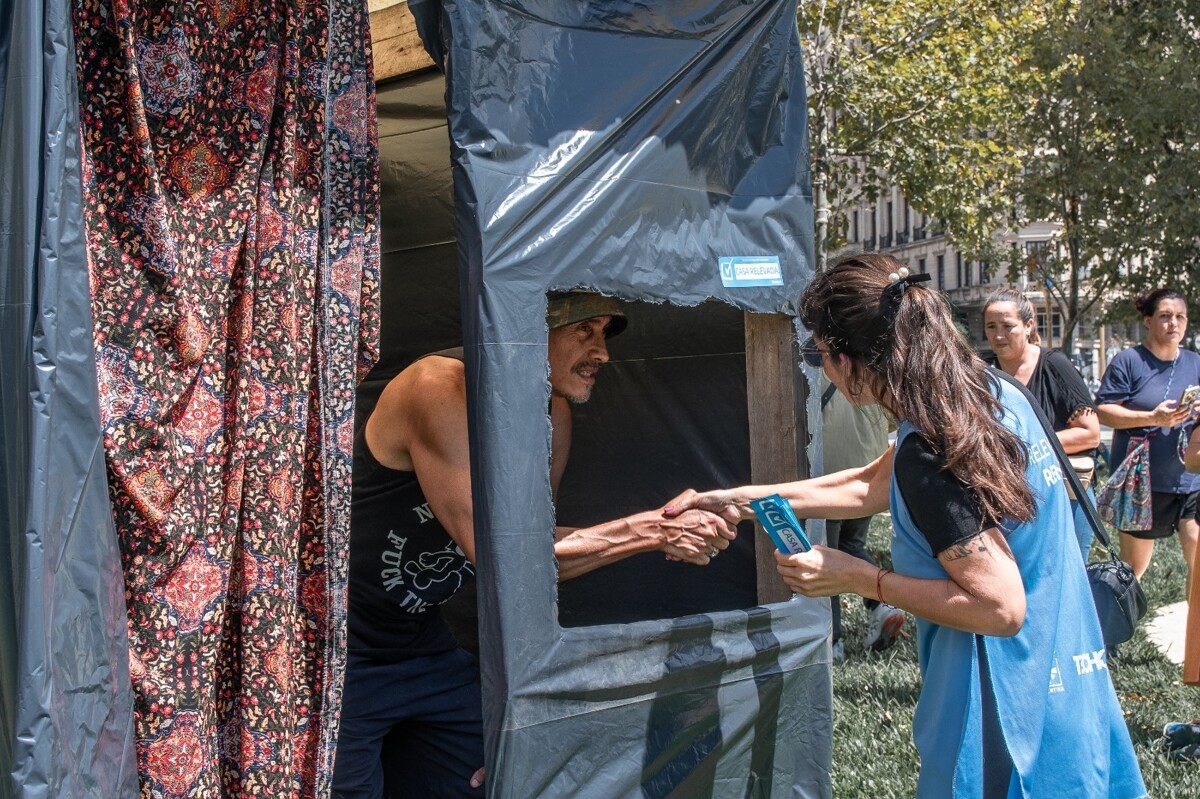
The government is buying time before the imminent closure of the only national body in charge of urbanizing popular neighborhoods. Yesterday at noon, workers and organizations mobilized in front of the Ministry of the Nation's Economy, located in the city of Buenos Aires, to protest the closure of the Undersecretariat for Sociourban Integration. The law established that the Undersecretariat for Sociourban Integration was the body in charge of planning the integration of popular neighborhoods and created the Sociourban Integration Fund, which was fed by the PAIS Tax to finance the works. «This law was created from the participation of thousands of neighborhood, villa, and community organizations that, through assemblies and meetings, debated what the best possible law for the urbanization of their neighborhoods was,» expressed Matías. «These are the immediate consequences of the closure of the SSISU,» said worker Matías Mora Caceres to ANRed. In this way, the national government decides to put an end to the only national body in charge of public policies for the urbanization of popular neighborhoods: «With the SSISU policy, 1,200 sociourban integration works had begun, 24,000 lots with services had already been delivered, and 250,000 women had benefited from housing improvements. Also, during its implementation years, 150,000 jobs related to construction, plumbing, electrical connections were generated, and today with the works paralyzed, those jobs are lost, affecting the internal economic engine of each neighborhood, purchases in hardware stores fall, internal consumption,» pointed out the worker. End to a unique policy of integration with social and community participation National Law 27.453 on the Sociourban Integration of Popular Neighborhoods was sanctioned in 2018 with the aim of urbanizing shantytowns and settlements in the country. Thanks to mobilizations and different instances of dialogue between the unions and the National Table of Popular Neighborhoods with the national government, through the Ministry of Economy, an extension of 290 contracts for workers who are part of the Undersecretariat and the continuity of the policy for two months was achieved. The destruction of the Undersecretariat's policy will affect 5 million neighbors of popular neighborhoods, 700 works will be left unfinished, more than 10,000 women will not be able to complete the 'My Room' program, 500,000 families will not be able to access the Family Housing Certificate, and 20,000 will not be able to access their lot. The end of this policy breaks with the organized community, interrupts integration, and deepens the vulnerability of families in the neighborhoods, leaving that space to criminal networks. More info: The government seeks to eliminate the only urbanization policy for shantytowns and settlements at the national level. And he explained: «Here is a fundamental difference that this policy has with traditional interventions in neighborhoods, because the policy of this law has as its backbone sociourban integration, that is, that the neighborhood is integrated into the rest of the city in terms of infrastructure; but that it is also integrated, by creating more community in the neighborhood. But the law not only incorporates infrastructure for services, housing, but also addresses the importance of strengthening the social fabric in the neighborhoods, such as the generation and creation of community institutions, clubs, sports fields, cultural, educational spaces, etc. Because many times what happened was that leaders, companies, cooperatives presented perhaps projects that were not the priorities for the neighborhood, so they were required to have at least four assembly meetings with the neighbors and present their conformity, at least from half of the neighbors. All this is included in the law and is part of many of the works that were carried out. The SISU has had recognition from international organisms and has been taken as an example to replicate in other parts of the world,» said Matías, a worker at the SSISU. If the final closure of the now defunded Undersecretariat is confirmed, 5 million people living in popular neighborhoods will be affected by the cessation of works, 290 workers will join the long line of the unemployed, and an incalculable loss of jobs will occur in the neighborhoods. Its closure implies the loss of work for its 290 workers but also affects the neighborhood cooperatives in charge of executing the works and 5 million people who depend on these policies to access basic services that make for more dignified living conditions. Extrapolating from the structural social inequality that exists in the world and in the country, the former president prefers to pretend to ignore the data: in Argentina there are 6,467 popular neighborhoods where about 5 million people live. 89% of these neighborhoods do not have access to running water; 98% lack a sewer network; 68% do not have a home electricity meter and depend on precarious and dangerous connections; 99% have no gas network; in 90% of families, they do not have property title to their homes and 1 in 3 live in precarious and overcrowded conditions. In line with its ally, the national government also decides to ignore and only look at the numbers of fiscal adjustment. That is why the Law that was gestated in the heat of the debate and participation of those who inhabit the territory proposed a new paradigm where the focus was placed on sociourban integration. «A municipality, a company or cooperative could not come and say to the SISU, 'I want to make a plaza', because from the Secretariat we would answer that they present the neighbors' conformity with that plaza.» The National Registry of Popular Neighborhoods (RENABAP) was the engine for the law. Also, the law and the Secretariat itself had in its competencies training in construction trades, sewers, electricity, plumbing, and others like cell phone repair. This is one of the points for which this law is a model, not only in the country but also in the rest of the world. Finally, on February 11, the authorities informed more than 290 workers and workers that their contracts will end on February 28: without an assigned budget, there are no works to execute. In response, yesterday at noon, workers, members of UTEP, ATE, social and political organizations, work cooperatives and civil associations that were part of the sociourban integration policies, held a press conference in front of the building and then marched to Plaza de Mayo where a symbolic land takeover was carried out by setting up typical shacks. Thanks to mobilizations and different instances of dialogue between the unions and the National Table of Popular Neighborhoods with the national government, through the Ministry of Economy, an extension of 290 contracts for workers who are part of the Undersecretariat and the continuity of the policy for two months was achieved. «We evaluate this as a gain of time for the government towards the closure that is expected to be imminent.» To intervene is not the same as to integrate In most cases, when the State —especially the provincial governments— have proposed urbanization programs, they have done so through interventions where the project is not decided in work tables with neighbors and organizations. On many occasions, even behind urbanization projects, gentrification processes are hidden that imply evictions and the breaking of the social bonds that are generated in the neighborhoods. A symbiotic relationship between the State, the community, and those who executed the project. The body went from being under the orbit of the then Ministry of Social Development, to the Ministry of Human Capital and now to Economy. This presented advantages: it involved the community in the project, made it a protagonist, consensus and commitment were generated. The Fund had previously suffered a strong cut, in February 2024, President Javier Milei reduced by decree the allocation of the PAIS Tax for the FISU from 9% to 0.3%, in practice, leaving it without resources until its closure almost a year later. In 2016 it was the social organizations (CTEP, CCC, Barrios de Pie, Techo y Cáritas) that began the territorial survey that was institutionalized the following year through decree 358/2017, creating the Registry. In May 2025, through decree 312/2025, the dissolution of the Sociourban Integration Fund (FISU) that financed the budget of the Secretariat for Sociourban Integration, degraded to an undersecretariat, was announced. Photos: Paula Somoza «The world is getting better every day and the poor of today live the same or better than a king 100 years ago because they have sewers, running water, access to public transport and public education in places where things work,» were the expressions of Mauricio Macri, a faithful ally of the government of Javier Milei, recently on a streaming channel. But it is much, much more than that. By Estefania Gonzalez, ANRed.